Overview
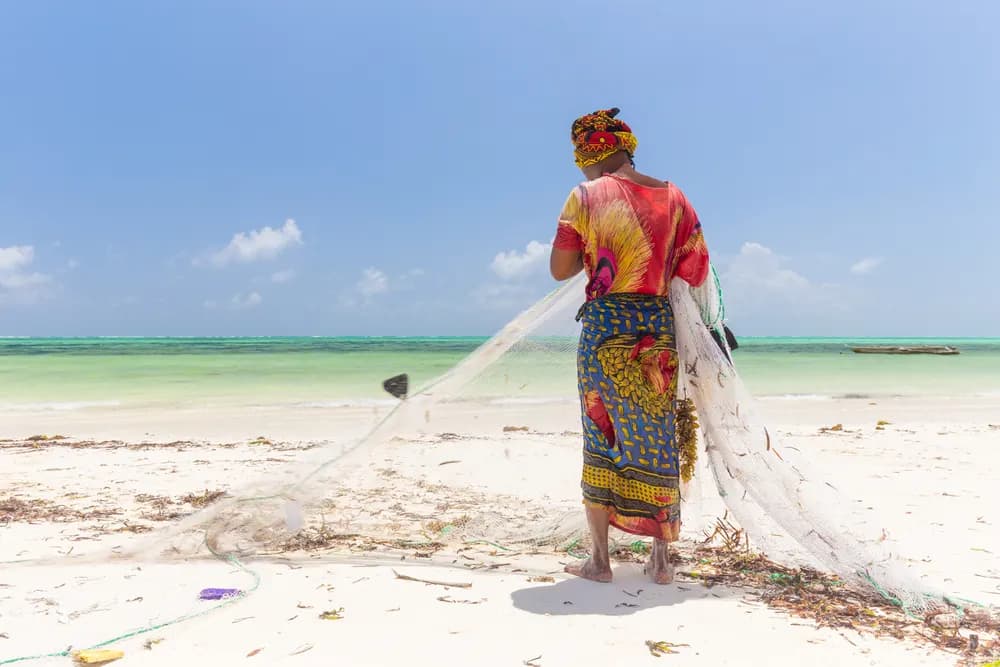
Six kilometres south of Paje, Jambiani is what many travellers hope Zanzibar will look like before they arrive: a working fishing village of whitewashed coral-rag houses, dhows drawn up on the sand, and women tending seaweed cultivation plots in the shallow lagoon at low tide. There are guesthouses and small hotels, but tourism here remains secondary to the rhythms of the fishing community and the tides. It is the antidote to Nungwi's resort strip.
The Beach and Tides
Jambiani's beach is strikingly long and wide — you can walk several kilometres north or south without interruption. The tidal range mirrors Paje's dramatic ebb and flow: at low water, the lagoon retreats far from shore, revealing the seaweed farming frames, tidal pools, and the coral rubble of the inner reef. At high tide the lagoon fills to waist-depth close to the beach, becoming calm, warm, and swimmable. The best swimming window is roughly two hours either side of high tide. Mornings often see fishermen sorting their catch on the sand; afternoons belong to the trade wind.
Village Life and Seaweed Farming
The seaweed cultivation is integral to Jambiani's economy and worth understanding rather than simply photographing. Women (primarily) plant, tend, and harvest Eucheuma cottonii on submerged frames staked into the sand at low-tide intervals. Several community tourism initiatives offer guided walks that explain the farming process, the drying and baling, and what the income means locally. These experiences are far more memorable than a snorkelling trip.
Where to Stay and Eat
Jambiani has a good range of small-scale accommodation: Red Monkey Lodge and Gomani Beach House cater to independent travellers; Casa del Mar and Sau Inn offer a modest step up in comfort. Local restaurants serve straightforward Swahili plates — grilled fish, rice and coconut sauce, cassava chips. Prices are noticeably lower here than anywhere on the north coast.
Getting There
From Stone Town the drive southeast takes about 65–70 minutes via the Tunguu–Makunduchi road. Dala-dalas run from Darajani but involve a change and take 1.5–2 hours. Taxis charge roughly $30–40 for the trip. Many travellers combine Jambiani with Paje (6 km north) in a single south coast itinerary.