Overview
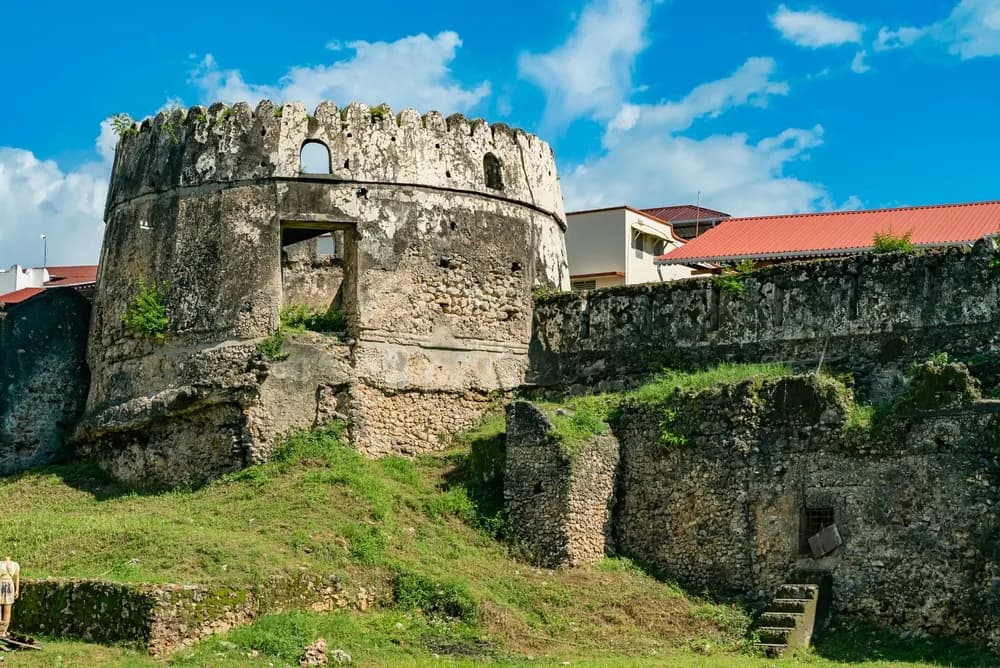
The Old Fort — Ngome Kongwe in Swahili, meaning "ancient fortress" — stands at the seafront edge of Stone Town and is the oldest surviving structure on the island of Zanzibar. Omani Arabs began building it in the late 1690s after they expelled the Portuguese from Zanzibar in 1698, and construction was largely complete by around 1701. The site they chose was significant: it stood on the remains of a Portuguese chapel dedicated to São Tiago, and recycled stonework from that earlier building is visible in the fort's lower courses.
Architecture and History
The fort is a blunt, functional piece of military architecture rather than an ornamental palace. Thick coral-rag walls rise to crenellated battlements, and two substantial round towers — one at the sea-facing northwest corner, one on the inland side — provided overlapping fields of fire to defend the harbour approach. A narrow entrance gate on the eastern side leads into a large open courtyard that originally served as a place of confinement and military assembly.
Under British colonial rule after 1890 the fort lost its defensive purpose. It was used variously as a railway terminus for a short-lived line to the interior, and later as a women's prison. For most of the twentieth century it sat underused until Zanzibar's government converted it into a cultural centre in the 1990s.
What to See and Do
Today the interior courtyard contains a small open-air amphitheatre used for evening performances and cinema screenings. A ring of craft stalls around the courtyard walls sells textiles, spices, carved wooden items, and jewellery — quality varies, but it is one of the better curated craft markets in Stone Town.
Every February the courtyard becomes the principal stage for Sauti za Busara, one of East Africa's most respected music festivals. The event draws taarab, bongo flava, afrobeat, and traditional music acts from across the continent and fills the fort with several nights of live performance.
Visiting Tips
- Admission to the fort grounds is free; individual events and the amphitheatre shows charge separately.
- The fort is immediately adjacent to Forodhani Gardens, making an evening combination straightforward.
- Craft stall bargaining is expected — opening prices are typically two to three times the seller's floor.
- The battlements are not open to visitors, but the courtyard alone is worth 30–45 minutes.
- Stone surfaces inside the fort offer welcome shade during the midday heat.