An archipelago in the western Indian Ocean
The Zanzibar Archipelago is a group of islands in the western Indian Ocean, lying between roughly 4°S and 7°S latitude off the coast of Tanzania in East Africa. The archipelago is defined administratively as the semi-autonomous region of Tanzania governed by the Zanzibar Revolutionary Government, and it consists of two main islands — Unguja and Pemba — plus a scattering of smaller islets, atolls, and coral outcrops. Mafia Island, sometimes grouped geographically with Zanzibar in older literature, is administered separately as part of the Tanzanian mainland's Pwani region and is not part of the Zanzibar Archipelago in the current political sense.
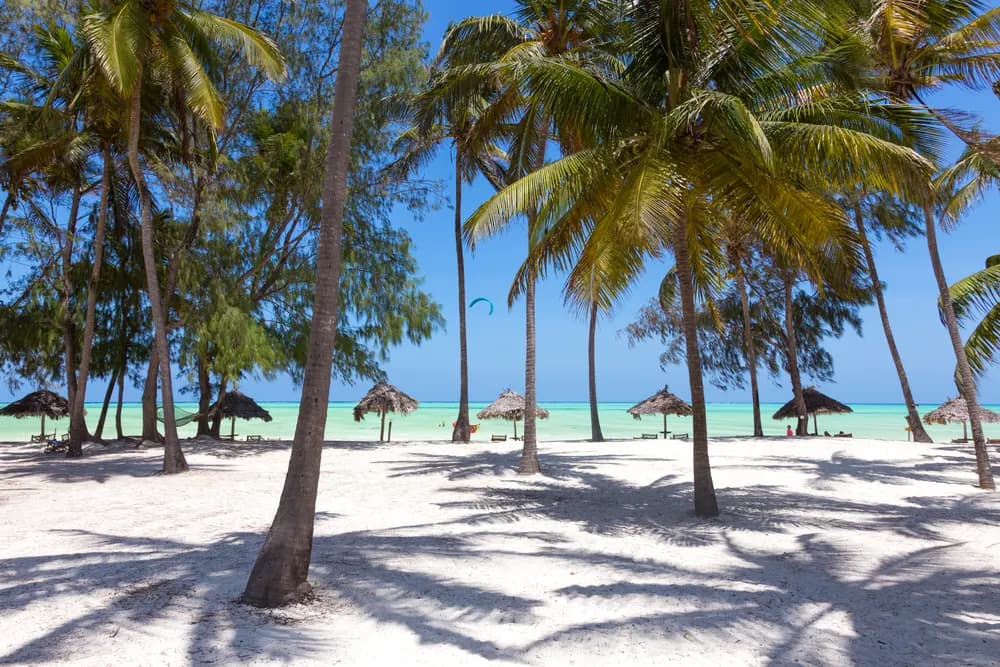
The islands sit on the continental shelf of East Africa, in relatively shallow water compared to the deep channels that drop away further east into the Indian Ocean basin. This geological setting — coral limestone platforms built on a shelf — explains both the character of the beaches (white coral sand, fringing reefs) and the generally low elevation of the islands.
Unguja: the main island
Unguja is the largest island of the archipelago, covering approximately 1,660 square kilometres, and is home to the vast majority of the population and all of the major tourist infrastructure. It is commonly called "Zanzibar Island" internationally, though the name "Zanzibar" in local Swahili usage more often refers to Stone Town or the archipelago as a whole rather than specifically to Unguja.
The island stretches roughly 85 kilometres from north to south and is relatively flat, with a central ridge reaching around 120 metres at its highest. Stone Town, the historic capital and UNESCO World Heritage Site, occupies a small peninsula on the western coast. The north coast (Nungwi, Kendwa) and east coast (Matemwe, Paje, Jambiani) are the primary beach zones. Jozani Chakawa Bay National Park in the south-centre of the island protects the last significant stands of indigenous coral rag forest and the endemic Zanzibar red colobus monkey.
Pemba Island
Pemba lies approximately 80 kilometres north-northeast of Unguja, at around 5°S latitude, and covers about 985 square kilometres. It is notably different in character from Unguja: more mountainous (rising to around 95 metres, but with dramatic topography by island standards), more densely forested, and far less visited by international tourists. The interior of Pemba is fertile — it was historically a major clove-producing island — with a landscape of rolling hills, small farms, and fishing villages.
The principal town is Chake Chake, in the centre of the island. Wete is the main northern town. Most visitors access Pemba by small aircraft from Zanzibar (Karume Airport on Unguja) or from Dar es Salaam; a weekly government ferry also connects Pemba to the mainland and occasionally to Unguja, but schedules are unreliable.
Pemba's international reputation rests almost entirely on its diving. The western edge of the island drops into the Pemba Channel, which reaches depths of over 700 metres — one of the deepest nearshore marine environments on the East African coast. The walls along Pemba's western coast are covered in dense soft coral and gorgonian fans, and the fish life is exceptional, including frequent sightings of large pelagic species.
Mnemba Atoll
Mnemba is a small private island and surrounding atoll off the northeast coast of Unguja, approximately 3 kilometres offshore from Matemwe. The island itself is owned privately and accessible only to guests of the exclusive lodge there, but the surrounding atoll — the Mnemba Atoll Marine Conservation Area — is open to licensed diving and snorkelling operators.
Mnemba Atoll is consistently rated among East Africa's finest dive sites. The coral formations are healthy and diverse, the fish populations are dense, and green turtles nest on the beaches of the island. Bottlenose and spinner dolphins are common in the waters around the atoll, and whale sharks pass through seasonally.
Chumbe Island
Chumbe Island lies off the southwestern coast of Unguja, roughly 12 kilometres south of Stone Town. It is the site of Chumbe Island Coral Park, a privately managed marine protected area established in 1994 and widely cited as a model for community-based conservation in the Indian Ocean. The reef around Chumbe is one of the most pristine in the region, protected from fishing and anchoring. The island also has a small area of intact coral rag forest. Day trips from Stone Town are available, and a handful of eco-bungalows accommodate overnight guests.
Tumbatu Island
Tumbatu lies off the northwest coast of Unguja, separated from the main island by a narrow channel. It is home to the Tumbatu people, one of the oldest indigenous communities of the Zanzibar Archipelago, who have a distinct dialect and cultural identity. Tumbatu is not generally open to visitors without specific community permission, and it remains one of the least touristed and most traditional communities in the archipelago.
Prison Island (Changuu)
Changuu Island — universally called Prison Island by visitors — sits roughly 5.5 kilometres northwest of Stone Town. The name is somewhat misleading: a building was constructed in the late 19th century, initially intended for use as a prison, but it was never used for that purpose and later served as a quarantine station. Today the island is visited primarily for its colony of Aldabra giant tortoises, originally brought from the Seychelles as a gift to the British Resident in the 1910s. The tortoises are now a well-established population and the main attraction of a popular half-day boat trip from Stone Town.