Travel Guide
Zanzibar City
Zanzibar City — the capital of the Zanzibar Archipelago, combining the UNESCO-listed Stone Town with the modern suburb of Ng'ambo.
Capital and gateway to the archipelago
Zanzibar City is the capital of the Zanzibar Archipelago and the largest urban center in the semi-autonomous region of Tanzania. It sits on a small peninsula on the western coast of Unguja — the main island — looking across the Zanzibar Channel toward the Tanzanian mainland some 35 kilometers away. The city is the political, commercial, and cultural heart of the islands, home to the government ministries of the Revolutionary Government of Zanzibar, the main port, the largest market, and the greatest concentration of hotels, restaurants, and historical monuments.
The city has two distinct parts that reflect two very different phases of its history: Stone Town, the ancient and UNESCO-recognized historic quarter, and Ng'ambo, the largely twentieth-century suburb that now holds the majority of the city's population.
Stone Town: the UNESCO core
Stone Town occupies the narrow peninsula itself and is the part of Zanzibar City that visitors come specifically to see. It was inscribed as a UNESCO World Heritage Site in 2000, recognized for its exceptional blend of Swahili, Arab, Indian, and European architecture accumulated over centuries of Indian Ocean trade.
The physical fabric of Stone Town is defined by coral rag — blocks of fossilized coral quarried locally and used as the primary building material — combined with lime plaster rendered over dense urban blocks that leave little space between buildings. Narrow, often roofless alleyways wind between these blocks in a pattern that pre-dates any urban planning grid, shaped instead by centuries of organic growth, property boundaries, and trade logic. The effect for a first-time visitor is one of deliberate labyrinthine enclosure: you are meant to slow down, to navigate by landmark rather than by cardinal direction, to enter the city on its own terms.
The architectural vocabulary of Stone Town is layered. At street level, the most celebrated element is the carved wooden door — hundreds survive across the town, decorated with geometric patterns, calligraphy, brass studs, and figural motifs that vary by the cultural tradition of the original owner. Arab-style doors traditionally have pointed arches; Indian-influenced doors are characterized by elaborate horizontal lintels and a wider repertoire of decorative carving. These doors were not merely decorative: the size and ornamentation of a door signaled the wealth and status of the household behind it.
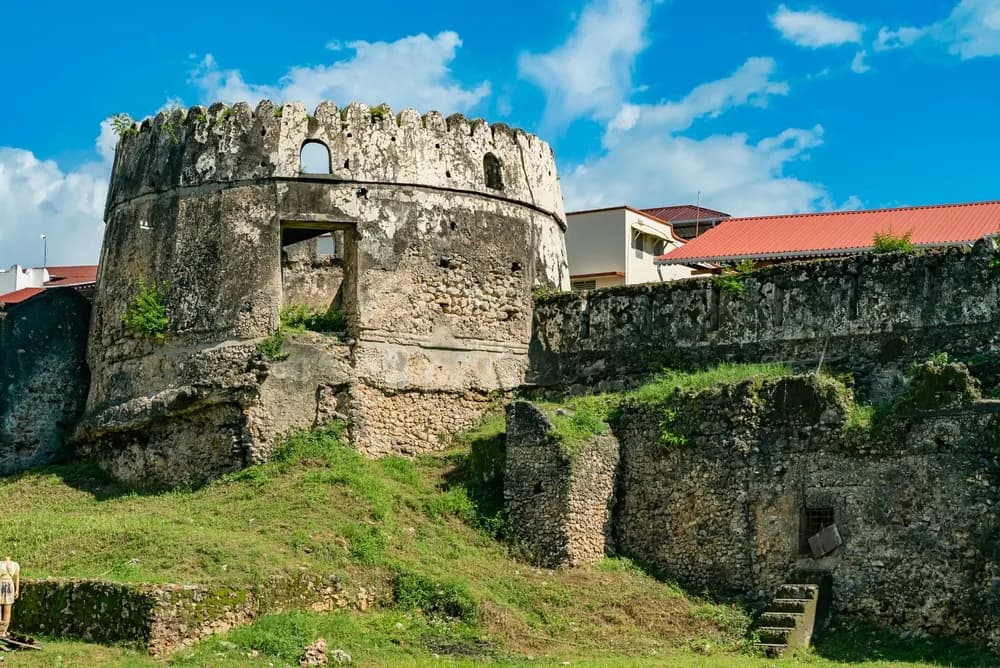
Above street level, carved balconies, shuttered windows, and projecting upper stories define the skyline of the taller merchant houses. The House of Wonders (Beit el-Ajaib) — built in 1883 as a ceremonial palace — stands on the seafront Forodhani waterfront and remains the most architecturally striking single building in Stone Town, its iron balconies and clock tower dominating the harbor front. Adjacent is the Old Fort (Ngome Kongwe), a seventeenth-century fortification built by Omani Arabs on the site of a Portuguese chapel, now used as a cultural center and open-air performance venue.
The Anglican Cathedral Church of Christ stands on the site of the last open slave market in East Africa — a deliberate act of symbolism by the Universities' Mission to Central Africa, which built the cathedral in 1879 after the slave market was closed in 1873. The altar is placed on the spot where the whipping post once stood.
Ng'ambo: the other side
The name Ng'ambo means "the other side" in Swahili, and it describes exactly what the district is: the part of Zanzibar City that grew up on the eastern side of the creek that once separated the peninsula from the mainland of Unguja. During the Sultanate period, Ng'ambo was the area where the majority of Zanzibar City's African population lived, in lower-density housing quite different from the stone merchant architecture of the peninsula.
Over the twentieth century, Ng'ambo expanded dramatically as Zanzibar City grew. Today it is the larger half of the city by population and area, and it functions as the working, everyday city: markets, bus terminals, commercial streets, government offices, schools, hospitals, and the neighborhoods where most Zanzibaris who are not in the tourist industry go about their lives. The Darajani Market, on the boundary between Ng'ambo and Stone Town, is the central produce and goods market for the whole city and one of the most atmospheric and practically useful places to spend an hour.
The port
The Port of Zanzibar, on the western seafront of Stone Town, is the principal maritime gateway to the archipelago. High-speed ferries connect Zanzibar City to Dar es Salaam on the Tanzanian mainland in approximately two hours; slower conventional ferries make the crossing overnight. Cargo dhows, fishing vessels, and small passenger craft also use the port. The ferry terminal, a short walk from the main hotel cluster, is a busy and sometimes chaotic place; arriving or departing by ferry gives a visceral sense of the sea traffic that has passed through this port for centuries.
Population and governance
Zanzibar City's population is estimated at around 250,000 to 300,000 people in the urban area, though precise figures vary depending on how the city boundaries are defined. The city is the seat of the Revolutionary Government of Zanzibar, which administers the archipelago under the semi-autonomous arrangement established by the Articles of Union of 1964. The Zanzibar House of Representatives and the offices of the President of Zanzibar are both located in the city. Politically, the city has historically been a competitive battleground between the ruling Chama cha Mapinduzi and the opposition Civic United Front and its successor formations.
Orientation and practicalities
Stone Town is entirely walkable, though the alleyway network is genuinely disorienting at first. Most visitor accommodation, restaurants, and attractions are within the Stone Town peninsula and within comfortable walking distance of each other. The main seafront road — known as Mizingani Road — runs along the western edge of Stone Town and provides a straightforward orientation axis. Dalla-dalla minibuses and shared taxis connect Zanzibar City to all other parts of Unguja from the main terminal near Darajani Market.
Frequently asked questions
- Is Stone Town the same as Zanzibar City?
- No. Stone Town is the historic core of Zanzibar City and a UNESCO World Heritage Site, but Zanzibar City also includes Ng'ambo, the larger modern suburb that developed to the east of Stone Town during the twentieth century.
- What is Zanzibar City the capital of?
- Zanzibar City is the capital of the Zanzibar Archipelago and the seat of the semi-autonomous Revolutionary Government of Zanzibar. It sits on the western coast of Unguja (the main island).
- How do I get from Zanzibar City to the beaches?
- Dalla-dalla minibuses and shared taxis connect Zanzibar City to beaches across Unguja. The north coast (Nungwi, Kendwa) takes around 1.5 hours by road; the east coast (Paje, Jambiani) takes around 45–60 minutes.